|
Imagine what would happen if you didn't care for your teeth regularly. The same basics of dental care also apply to your pet's teeth. Regular professional care from your veterinarian and effective daily home care from you will keep your pet's mouth healthy.
About 85% of adult dogs and cats have some form of periodontal disease. Periodontal disease occurs when plaque, a colorless film that contains bacteria, builds up. With time plaque causes bad breath, pain, and gingival infections. Ultimately this results in the loss of tissues and bone that supports the teeth. There is also evidence to suggest that the mouth can be a source of bacteria that can spread to the heart, liver, lungs, or kidneys.
Click here to visit the AVMA website on National Dental Month.
If your pet's mouth smells bad, its teeth are discolored, or its gums are inflamed they may need a professional dental cleaning. The dental cleaning procedure as performed at Wandermere Animal Hospital is explained below...
- Pre-op blood panel: This panel tests for anemia, liver and kidney disease, and diabetes prior to anesthesia.
- Anesthesia-Premedication: This intramuscular injection includes a sedative and a pain medication.
- Anesthesia-Induction: An intravenous catheter is placed to facilitate the use of intravenous anesthetic medications and as a port for any emergency drugs and fluids. This is an important safety measure. After an intravenous injection of general anesthesia is given an endotracheal tube is placed to deliver gas anesthesia.
- Dental Radiographs: We will take full mouth x-rays of your pets teeth to look for root infections and bone loss that are hiding under the gum line. This helps our doctors determine which teeth are healthy enough to save and which ones need to be removed.
- Dental Cleaning: The teeth are first cleaned with an ultrasonic scaler to remove tartar and plaque from the tooth's surface. Next our technician will clean above the gum line to remove plaque where you can't see it. If there are infected, loose, or damaged teeth the doctor may decide to extract them.
- Polishing: After scaling the teeth, a special paste is used to even out any irregular surfaces decreasing future build-up of plaque and tartar.
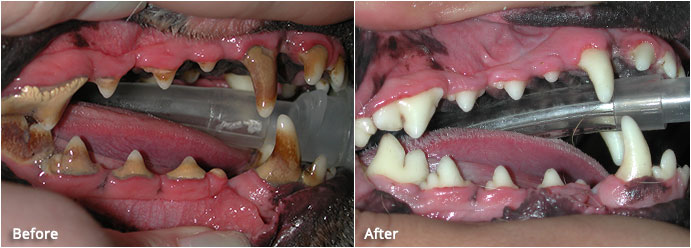
What about anesthesia-free cleanings?
The American Veterinary Dental College advises against anesthesia-free dental cleaning. To view their position statement click here.
Plaque should be removed from your pet's teeth every day before it mineralizes into tartar. Brushing your pet's teeth or feeding a dental food each day will control plaque buildup. If this is not practical or possible for your pet an antiseptic oral rinse or enzymatic dental chews may help kill bacteria in the mouth and reduce plaque buildup.
| 

 Processing ....